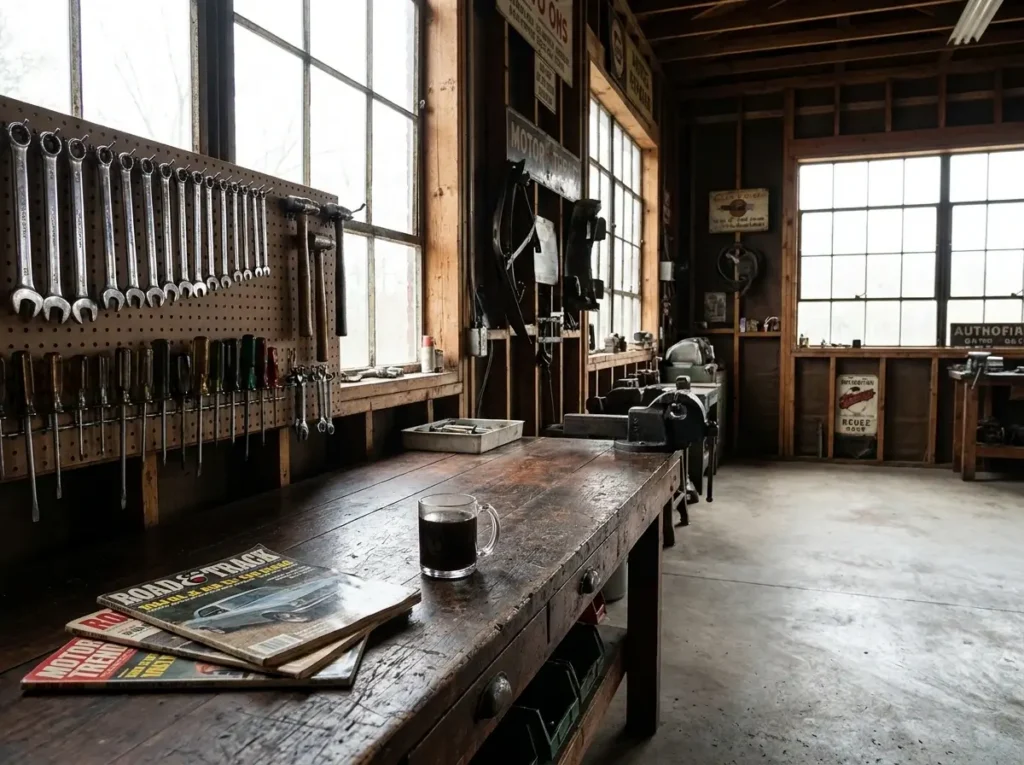
The silence in Marcus’s garage was a heavy, deliberate thing. He sat at his pristine, dust-free workbench, a mug of black coffee growing cold in his calloused hands.
Three years ago, he had locked the doors of his classic auto repair shop and refused to take another client. Now, the expensive tools hanging on the pegboard gleamed under the fluorescent lights, completely untouched. He ignored the stack of classic car magazines near his elbow, refusing to look at the world he had left behind.
It wasn’t just that he had gotten older; it was that the world had moved on. Cars were rolling computers now, solved by digital diagnostic machines and software updates rather than tactile intuition and grease.
He wiped down a perfectly clean wrench with a microfiber cloth, the familiar weight of the steel offering a hollow comfort. His hands, shaped by decades of bending metal, felt entirely obsolete in a trade that no longer required them.
Marcus maintained a strict morning routine to fill the quiet emptiness of his days. Every morning, he wiped down the empty benches, checked the locks, and walked the length of his long gravel driveway to collect the mail. He expected another perfectly predictable Tuesday—bills, flyers, and the quiet march toward an afternoon of nothing.
But the routine shattered when a flatbed truck backed into his driveway, the air brakes hissing loudly. Before Marcus could object, the driver lowered a wooden pallet onto the concrete and drove off without a word.
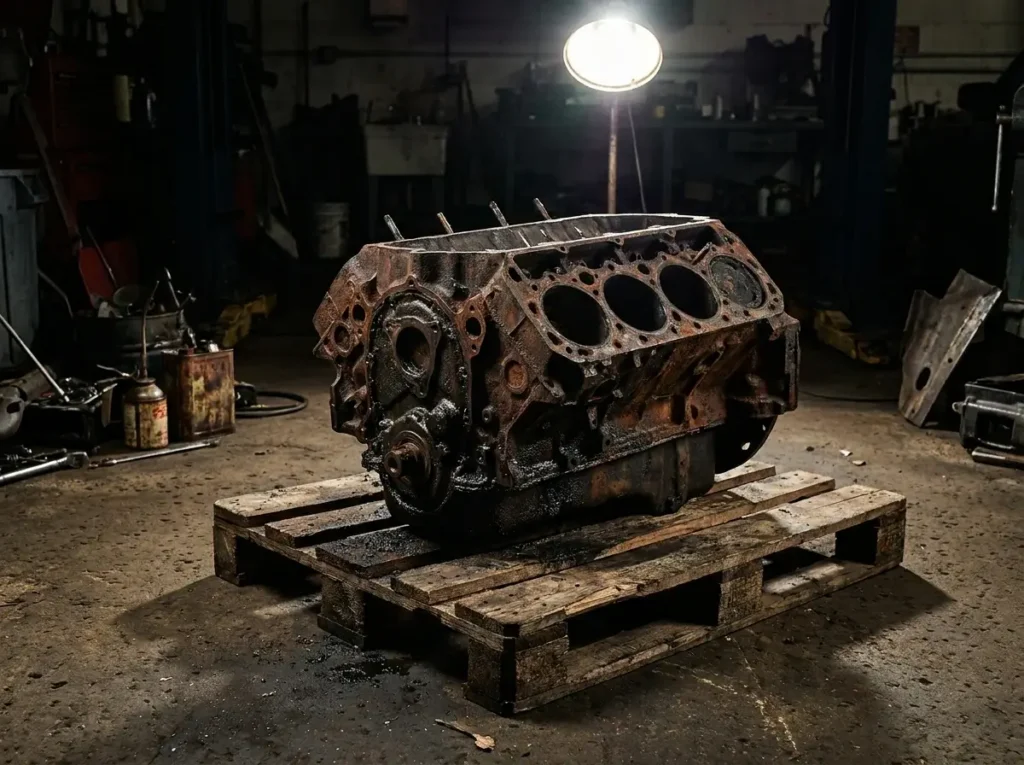
Sitting on the splintered wood was a rusted, partially dismantled 1970s engine block. It leaked dark sludge onto his clean driveway. Tucked beneath a rusty spark plug wire was a heavy envelope. Marcus snatched it up. The handwriting on the note was jagged, clumsy, and instantly recognizable. You’re the only one who can finish this. It was signed by Elias.
A sudden, defensive anger flared in Marcus’s chest. Elias had been his business partner forty years ago, before a bitter falling out turned them into fierce rivals. They hadn’t spoken since. For Elias to dump a piece of scrap metal on his property felt like a deliberate insult.
The Familiar Weld
Marcus wasn’t going to let a pile of junk sit on his property. He marched into the garage, furious, and grabbed a pair of heavy leather gloves and a shop rag. He would haul this rusted block directly to Elias’s pristine, high-tech facility across town and throw it back onto his immaculate showroom floor.
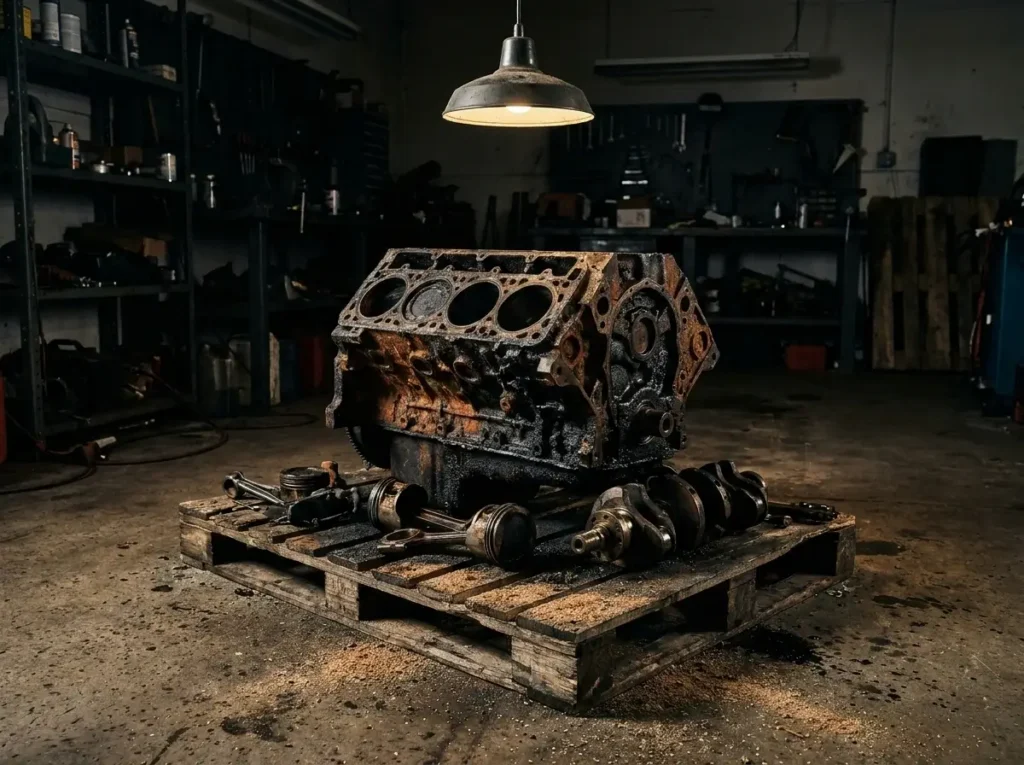
He dropped the tailgate of his truck and leaned over the pallet, wiping away a thick layer of grime to find a solid grip. As the rag cleared the grease from the intake manifold, Marcus stopped dead.
His thumb traced an ugly, clumsy, highly specific bead of metal on the cast iron. It was a custom weld. More specifically, it was the first weld they had ever done together, at seventeen years old, trying to piece together a scrap-yard engine in Elias’s parents’ barn. This wasn’t a random piece of junk sent to mock him. It was the heart of the very first car they had built together, long before the rivalry, the pride, and the silence.
He couldn’t throw it away. Instead, he dragged the heavy block into his shop and hoisted it under the harsh glare of a single work light.
The damage was extensive. The replacement parts it needed hadn’t been manufactured in decades. Marcus walked over to his dormant metal lathe and powered it on. The low hum vibrated through the floorboards. As he measured the manifold, he quickly realized that the repair would require an immense physical toll. He had to fabricate the missing pieces by hand. But he couldn’t guess the original clearances. He needed the old blueprints, and only one person had them.
What the Glass Revealed
The next morning, Marcus drove to Elias’s state-of-the-art shop. He planned to burst in, demand the original clearances, and prove he could still outwork his former partner. He pushed past the front desk and strode directly into the back office, the old anger fueling his steps.
He stopped in the doorway. Elias sat alone at his desk, his shoulders hunched. He was clutching a heavy magnifying glass, moving it painfully slow across a basic schematic. Elias looked up, squinting toward the doorway, his eyes clouded and unfocused. He wasn’t trying to finish a project for a wealthy client, nor was he trying to prove a point about modern engineering. Elias was rapidly losing his eyesight.
The anger drained out of Marcus, leaving a heavy silence in its place. Elias set the magnifying glass down on the desk. He confessed, his voice quieter than Marcus remembered, that the darkness was closing in faster than the doctors had predicted. He just wanted to hear their original engine run one last time before he went completely blind.
The forty-year rivalry had masked a deep, unspoken mutual respect that neither had been willing to admit until they were running out of time.
Marcus didn’t argue. He took the schematics, returned to his garage, and worked through the night. The lathe spun for hours, shaving ribbons of metal onto the floor. His hands cramped, his knuckles ached, and the immense pressure of Elias’s fading window of time weighed heavily on every movement.
The Final Fitting
In the early hours of the morning, Marcus’s exhaustion finally caught up with him. He was machining a crucial custom valve, applying pressure against the spinning metal, when his grip slipped. The valve bent with a sickening snap.
Marcus dropped his tools. The metal clattered loudly against the concrete. His hands were trembling, his joints aching in ways they never used to. He stared at the ruined piece under the harsh light, a crushing defeat settling over him. His deepest fear—that he was truly obsolete, that he had lost his touch—felt undeniably real. He realized he couldn’t finish it alone in isolation.
As the sun rose, Marcus loaded the nearly finished engine block, the raw materials, and his portable tools into his truck. He drove back to Elias’s shop. In the back bay, the restored chassis of their original car was waiting.
Elias was standing near the fender, staring blankly at the metal. Instead of trying to fabricate the valve himself to prove his superiority, Marcus walked over and placed his heavy tools directly into his rival’s trembling hands.
“I need your help,” Marcus said.
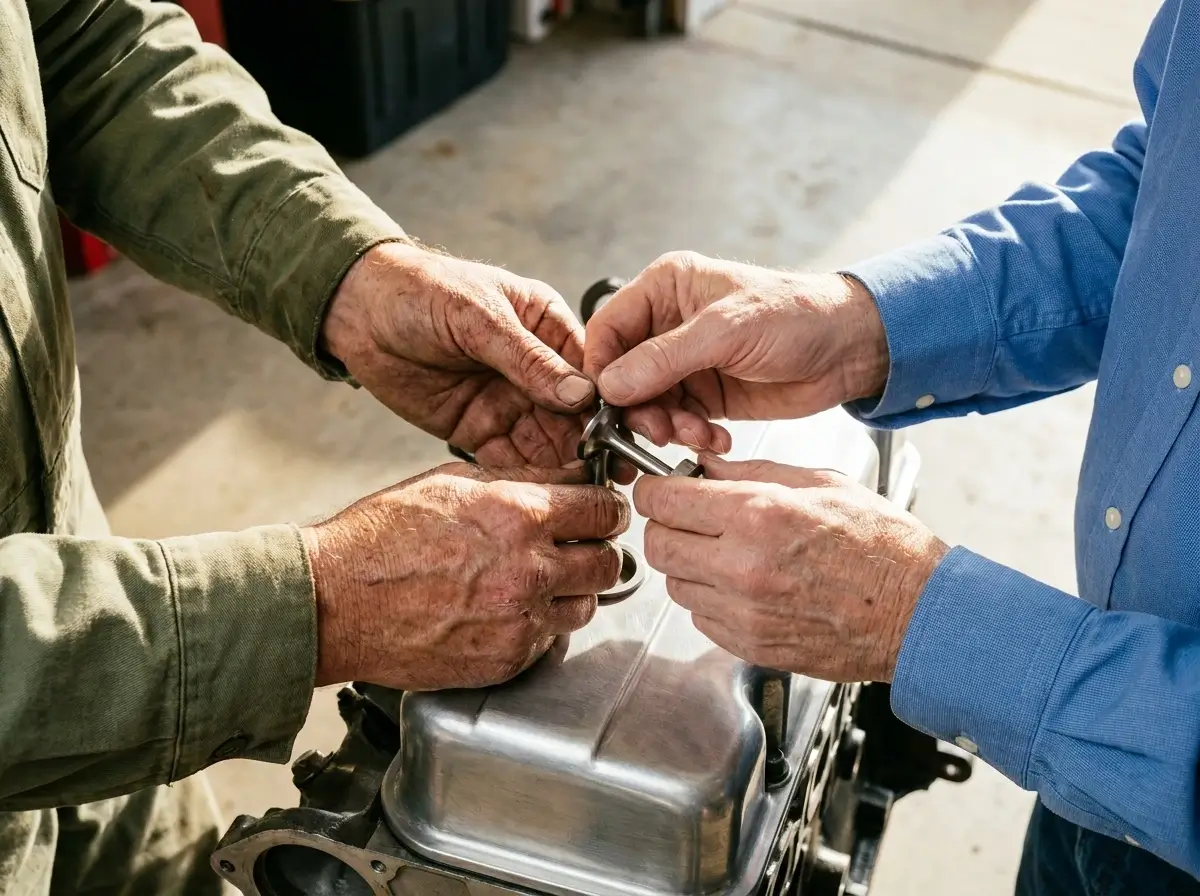
Marcus placed his calloused hands over Elias’s. Together, they guided the tools, feeling the shape of the metal, relying on forty years of muscle memory rather than sight. They shaped the final piece and installed it into the manifold, moving in a silent rhythm they hadn’t shared in decades.
Marcus stepped back and turned the key. The engine coughed once, then roared to life, running with a perfect, rhythmic hum. Marcus watched as Elias leaned toward the sound, tears forming in the blind man’s eyes. In the sunlit garage, the rift was permanently gone, replaced by the deep, quiet roar of what they had built together.
This is an original work of fiction. Characters and events were created for entertainment and emotional reflection.